
 Introduction
Tucked deep in the American South, Alabama is a land of rhythm, resilience, and remarkable contrasts. From the soulful sounds of Muscle Shoals to the sunlit shores of the Gulf Coast, Alabama is a place that tells the story of America itself — a story of struggle and triumph, of music and faith, of food and family.
It’s easy to think of Alabama as simply “The South,” but it’s so much more than that. It’s where rockets launched us to the moon, where gospel and blues gave birth to rock ’n’ roll, and where history—both painful and powerful—shaped the conscience of a nation.
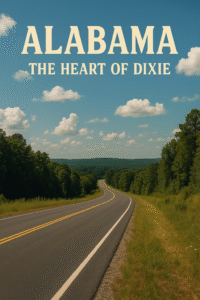
So, buckle up, traveler. We’re heading down red clay backroads, through misty pine forests, and into cities that hum with history and heart. Welcome to Alabama, the Heart of Dixie.
1. The Name and the Motto: Meaning and Identity
State Name: Alabama
Origin: The word Alabama is derived from a combination of Native American Choctaw words — alba (meaning “plants” or “weeds”) and amo (“to clear”). Together, they roughly translate to “clearers of the thicket,” referring to early tribes who cleared land for settlement.
State Motto: “Audemus jura nostra defendere” — Latin for “We Dare Defend Our Rights.”
This bold motto, adopted in 1923, reflects the state’s deep sense of pride and independence. Throughout its history — from frontier days to the civil rights movement — Alabama has embodied both fierce self-reliance and an unshakable spirit of determination.
Nickname: The Heart of Dixie
During the 1940s, Alabama’s Department of Tourism coined the phrase “Heart of Dixie” to highlight its central place in the Deep South’s culture and history. The name stuck — and even today, it’s proudly displayed on some of Alabama’s license plates.
2. A Journey Through Time: Alabama’s Story
The First Inhabitants
Long before Europeans arrived, the land we now call Alabama was home to powerful Indigenous nations — the Creek, Cherokee, Choctaw, and Chickasaw. Their cultures were rich and deeply connected to the land, rivers, and forests that defined the region.
Colonization and Conflict
The first European explorers arrived in the 1500s — Spanish conquistador Hernando de Soto being among the earliest. Over the next centuries, Alabama became a tug-of-war between Spain, France, and Britain before finally falling under American control after the Revolutionary War.
In 1819, Alabama became the 22nd state in the Union. But the decades that followed were tumultuous. As cotton boomed, slavery became the backbone of its economy, setting the stage for deep division.
Civil War and Reconstruction
When the Civil War erupted in 1861, Alabama seceded from the Union and joined the Confederacy. The city of Montgomery even served briefly as the first capital of the Confederate States of America.
The war left Alabama devastated — its economy shattered, its cities burned. But out of the ashes came a long, painful road toward rebuilding and reconciliation.
Civil Rights and Courage
A century later, Alabama again stood at the crossroads of history. Cities like Birmingham, Montgomery, and Selma became battlegrounds for equality and justice during the Civil Rights Movement of the 1950s and 1960s.
From Rosa Parks’ bus seat in Montgomery to Dr. Martin Luther King Jr.’s march in Selma, the world watched as ordinary Alabamians displayed extraordinary courage.
Today, Alabama’s civil rights legacy is preserved through museums, memorials, and historic landmarks that serve as powerful reminders of how far we’ve come — and how far we still have to go.
3. The Modern Alabama: Innovation, Industry, and Pride
Alabama has quietly become an economic powerhouse. The state’s once-rural landscape is now dotted with aerospace, automotive, and technology industries.
-
Huntsville, nicknamed “Rocket City,” is home to NASA’s Marshall Space Flight Center — where the Saturn V rocket that launched the Apollo missions was developed.
-
Mobile, a bustling port city on the Gulf of Mexico, connects Alabama to global trade and vibrant maritime culture.
-
Birmingham, once known for steel, is now a hub of medicine, banking, and art.
Despite modernization, Alabama hasn’t lost its soul. Drive through small towns like Eufaula, Monroeville, or Fairhope, and you’ll still find old-fashioned hospitality, front porches, and the slow, sweet drawl that reminds you — you’re in the South.
4. Cities and Destinations You Shouldn’t Miss
📍 Birmingham: The Magic City
Named for its explosive growth during the Industrial Revolution, Birmingham has transformed from a steel town into a cultural and culinary hub.
Visit the Birmingham Civil Rights Institute, stroll through Railroad Park, and grab dinner in the trendy Avondale district, where barbecue meets craft beer.
📍 Montgomery: Where History Walks Beside You
The state capital, Montgomery is where Rosa Parks sparked the bus boycott and Dr. King led the charge for justice.
Walk the Selma-to-Montgomery National Historic Trail, visit the National Memorial for Peace and Justice, and tour the Alabama State Capitol, where history echoes through every hallway.
📍 Huntsville: Rocket City USA
Science lovers rejoice — Huntsville is where space dreams took flight. The U.S. Space & Rocket Center is a must-see, with towering rockets and simulators that make you feel like an astronaut for a day.
The city also surprises visitors with its arts scene and nearby Monte Sano State Park, where hiking trails overlook the Tennessee Valley.
📍 Mobile: Southern Charm by the Sea
Founded in 1702, Mobile is one of America’s oldest cities — and the original home of Mardi Gras (sorry, New Orleans).
Explore the USS Alabama Battleship Memorial Park, wander through historic Dauphin Street, and relax on nearby Dauphin Island, a paradise for birdwatchers and beachgoers alike.
📍 Gulf Shores & Orange Beach: Alabama’s Coastal Escape
You don’t have to go to Florida to find sugar-white sand and turquoise water. Alabama’s Gulf Coast beaches are every bit as beautiful — and often far less crowded.
Enjoy seafood shacks, dolphin cruises, and sunsets that set the sky on fire.
5. Nature’s Beauty: Parks and Outdoor Adventures
🌲 Cheaha State Park
At 2,413 feet, Cheaha Mountain is Alabama’s highest point — and home to breathtaking vistas, waterfalls, and hiking trails. It’s part of the Talladega National Forest, where the air smells like pine and freedom.
🦋 Little River Canyon National Preserve
Known as the “Grand Canyon of the East,” this 14,000-acre preserve features rugged cliffs, waterfalls, and clear swimming holes. It’s a paradise for hikers, kayakers, and photographers.
🐊 Bon Secour National Wildlife Refuge
Along the Gulf Coast, this sanctuary protects migratory birds, sea turtles, and rare coastal ecosystems. It’s a peaceful escape that feels a world away from city life.
🌾 Noccalula Falls Park
Located near Gadsden, this 90-foot waterfall plunges into a lush gorge surrounded by legends of Native American history and love.
6. Cultural Life: Music, Food, and Festivals
🎵 Music Heritage
Alabama’s influence on American music can’t be overstated. The small town of Muscle Shoals birthed hits for legends like Aretha Franklin, The Rolling Stones, and Lynyrd Skynyrd. The Muscle Shoals Sound Studio still operates today, open to visitors eager to stand where musical magic was made.
🍗 Food & Flavors
From fried green tomatoes to smoked ribs and catfish, Alabama’s food scene is comfort food heaven.
-
Try: White barbecue sauce in Decatur, shrimp and grits on the coast, and pecan pie anywhere.
-
Drink: Sweet tea — it’s practically the state beverage.
🎉 Festivals & Fun
-
National Shrimp Festival (Gulf Shores)
-
Hangout Music Festival (Orange Beach)
-
Rocket City Brewfest (Huntsville)
-
Mobile Mardi Gras — the original and still one of the best!
7. Fun Facts and Surprises
-
State Bird: Yellowhammer (hence Alabama’s nickname, “The Yellowhammer State”)
-
State Flower: Camellia
-
State Tree: Longleaf Pine
-
Famous Alabamians: Helen Keller, Harper Lee, Nat King Cole, Hank Williams Sr.
-
Sports Passion: College football isn’t just a pastime — it’s religion. The Iron Bowl between Alabama and Auburn divides families (in a good-natured way… mostly).
And here’s a little-known fact: Alabama was the first state to declare Christmas a legal holiday — all the way back in 1836. 🎄
8. Road-Trip Ideas: Exploring the Heart of Dixie
If you want to experience Alabama like a local, try this 5-day driving itinerary:
Day 1: Birmingham → Tuscaloosa
Discover civil rights landmarks, jazz bars, and college town energy.
Day 2: Tuscaloosa → Montgomery
Visit the Rosa Parks Museum and the Civil Rights Memorial.
Day 3: Montgomery → Selma → Mobile
Follow the historic Selma-to-Montgomery route, then head south for seafood and salt air.
Day 4: Mobile → Gulf Shores
Relax by the ocean, grab dinner at The Hangout, and catch a sunset on the pier.
Day 5: Gulf Shores → Huntsville
End your trip at the U.S. Space & Rocket Center — because why not end your journey reaching for the stars?
9. The Spirit of Alabama
Alabama isn’t just a state — it’s a story. It’s about perseverance, pride, and progress. It’s about communities that rebuild, music that heals, and landscapes that remind you how vast and beautiful this country truly is.
From its soulful cities to its quiet backroads, Alabama invites you to listen — to its past, its people, and its promise. Whether you come for history, food, or adventure, you’ll leave with a piece of Alabama’s spirit tucked in your heart.
So, traveler, next time your GPS tempts you toward the same old tourist routes, take the road less traveled. You might just find yourself humming “Sweet Home Alabama” for real.
© Great American Trails | Exploring the Roads Less Traveled